
Back-to-school writing: 5 ways to keep your child’s creativity alive this term

This article gives parents five practical ways to keep children aged 9 to 15 writing throughout the school term: create short, manageable writing habits; make reading and storytelling part of family weekends; celebrate small writing victories; turn school topics into inspiration; and protect unstructured time for imagination.
It also encourages parents to separate creativity from correction. Rather than focusing immediately on spelling, punctuation or producing a perfect finished story, children need opportunities to experiment, make mistakes and discover their own voices.
How to help a young writer finish their first book | Parent Guide
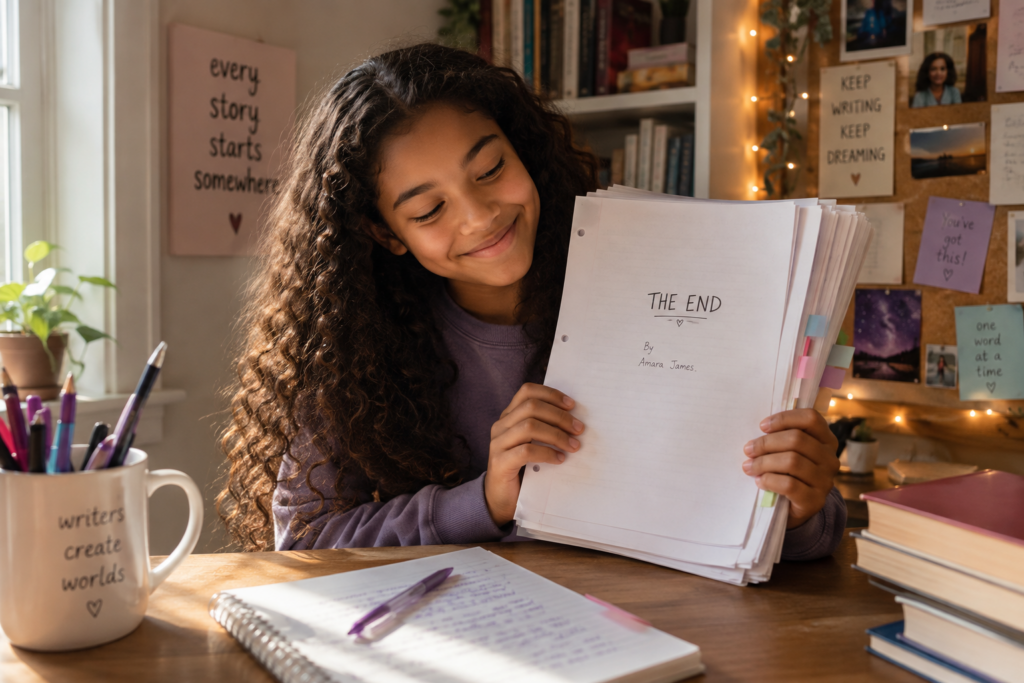
Does your child have notebooks full of brilliant story ideas but struggle to reach “The End”? Finishing a first book takes more than imagination. Young writers also need structure, consistency, encouragement and the confidence to keep going when the initial excitement wears off.
In this article, I share seven practical ways parents can support a child’s writing journey without taking over their story. From choosing a manageable project and creating a simple story plan to setting realistic writing goals, building a routine and navigating the difficult middle, these strategies help children turn exciting ideas into completed work.
I also explore when a young writer might benefit from additional support through a creative writing programme or dedicated writing mentor. The difference between an unfinished story and a completed manuscript isn’t talent, it’s having the right support at the right time.
Behind the scenes of our Summer Storytelling Camp (and what’s next for your child)

What happens when you put a group of young writers together and tell them to let their imaginations run wild? A LOT of stories!
Our Young Writers Summer Storytelling Camp was filled with characters, imaginary worlds, plotting, creative challenges, laughter and, most importantly, young people discovering the confidence to tell their own stories.
We explored character development, setting, story structure and the all-important question: “What happens next?”
Summer may be ending soon, but their writing journey doesn’t have to.
Our Creative Writing Club for Kids and Teens returns this September, giving young writers a supportive space to keep creating, learning and developing their storytelling skills throughout the term.
Does your child love books, make up stories, fill notebooks with ideas – or simply have an imagination that needs somewhere to go?
Registration for September is now open. Come and discover what your young writer can create!
How to support and encourage a child who loves writing stories

If your child is always making up stories, filling notebooks with ideas, or disappearing into books for hours, they may have the heart of a young writer. The good news is that you don’t need to be a writing expert to nurture their creativity.
This article shares five practical ways parents can encourage a child’s love of storytelling without turning writing into another school assignment.
You’ll discover how creating a dedicated writing space, providing inspiring resources, celebrating imagination over perfection, becoming an enthusiastic audience, and helping your child connect with other young writers can build confidence and develop lifelong writing skills.
5 steps to use creative writing for your child’s emotional intelligence

This article explores how creative writing helps children develop emotional intelligence alongside their literacy skills. Rather than simply improving grammar or storytelling, writing gives children a safe space to understand and express their feelings, develop empathy, solve problems creatively, and build confidence.
The article highlights that emotional intelligence is built through consistent practice, not perfection. By nurturing a child’s imagination and giving them the freedom to explore emotions through stories, parents help them become not only better writers, but also more resilient, empathetic, and emotionally aware individuals.
Six signs your child might have a writing talent

This article helps parents identify six often-overlooked signs that their child may have a natural talent for writing. While writing ability isn’t always reflected in perfect spelling, neat handwriting, or top grades, it often reveals itself through curiosity, imagination, observation, empathy, and a deep love of stories.
The article outlines six key indicators of writing talent, including being an avid reader, having a vivid imagination, noticing small details others miss, demonstrating emotional intelligence, using writing to process feelings, and showing a fascination with words and language.
Creative indoor activities for book-loving kids

This article gives parents practical and creative ways to keep book-loving kids engaged during the summer holidays. Rather than simply reading books, children are encouraged to interact with stories through activities such as creating book trailers, designing character scrapbooks, rewriting endings, building fictional worlds, casting movie adaptations, and starting book review blogs or Bookstagram accounts.
These activities help children develop critical thinking, creativity, storytelling skills, and confidence while making reading more interactive and fun. The article also highlights how these projects can be a natural stepping stone from being a reader to becoming a writer.
My child loves writing: what should I do next?

This article is a practical guide for parents who have realised that their child has a genuine love of writing. It explains that once a child begins filling notebooks with stories, poems, or even their own comics, the next step is to nurture that passion without turning it into pressure.
Parents should take their child’s writing seriously, create a dedicated writing space, fuel their creativity through reading, and focus on storytelling rather than grammar in the early stages. It also highlights the importance of celebrating their work, entering writing competitions, and seeking professional guidance when appropriate.
Most importantly, it reminds parents that writing is a craft that grows through encouragement, confidence, and consistent practice. With the right support, a child who loves writing today could become a published author tomorrow.
Why creative writing is one of the best holiday activities for children

This article highlights why creative writing is one of the most valuable holiday activities for children aged 9–15. While many parents worry about boredom, excessive screen time, and the “summer slide” during school breaks, creative writing offers a fun and engaging way to keep young minds active.
The article explains how writing helps children maintain and improve literacy skills, including grammar, vocabulary, critical thinking, and communication. It also provides a safe outlet for self-expression, helping children process emotions, build empathy, and develop emotional intelligence.
Beyond academic benefits, creative writing encourages creativity, reduces screen time, and boosts confidence. Completing a story gives children a sense of accomplishment and ownership that can positively impact other areas of their lives.
The article also shares practical tips for motivating reluctant writers and suggests joining a writing community or summer storytelling programme to help children stay inspired and engaged throughout the holidays.
How to inspire your child to start writing stories

Whether your child is naturally drawn to books or seems more interested in video games and sports, every kid has stories inside them waiting to come out. As parents and carers, we have the power to unlock that creativity and help our children discover the joy of bringing their imaginations to life through words.
The magic happens when you start writing. Once your fingers are moving and words are appearing on the page, momentum builds. You remember that you actually can do this writing thing.
Struggling with writer’s block? 50+ creative writing prompts to get unstuck

A good prompt does three things: it gives your brain a specific starting point, removes the paralysis of infinite choice, and tricks you into writing without the weight of expectations. You’re not writing your magnum opus: you’re just responding to a silly scenario about a talking frog or exploring what happens when someone receives an unusual gift.
The magic happens when you start writing. Once your fingers are moving and words are appearing on the page, momentum builds. You remember that you actually can do this writing thing.
How to develop strong characters your readers will love

You’ve probably experienced it yourself: getting completely absorbed in a book because you genuinely cared what happened to the main character. Maybe you stayed up way too late reading because you had to know if the heroine would end up with her Prince Charming, or you found yourself rooting for your favourite character even when she made questionable decisions.
The business side of self-publishing for nonfiction authors

Most nonfiction writers dive into self publishing thinking it’s just about getting their expertise out there. But if you want to make real money and build a sustainable career, you need to think like a business owner, not just an author.
Why creative writing should be in every school curriculum

Creative writing is not just some “nice-to-have” elective that gets cut when budgets tighten. Creative writing should be as fundamental to education as math and science.
Writing Stories with Plot Twists That Readers Don’t See Coming

You know that feeling when you’re reading a book and BAM, the twist hits you like a freight train? Your jaw drops, you flip back through pages thinking “How did I miss that?” and you immediately want to tell everyone about it. That’s the magic we’re chasing as writers. The plot twist that feels both completely shocking and utterly inevitable once it’s revealed.
How to Turn Everyday Chaos Into Compelling Stories

Imagine seeing all these writers sharing their amazing life experiences, and you’re thinking, “My life is just ordinary chaos. Who wants to read about my commute disasters or my kid’s meltdown at the grocery store?”
Three Small Writing Habits That Can Change Your Whole Year

You don’t need hours. You don’t even need 30 minutes. With just 10 minutes a day and the right approach, you can completely transform your writing life over the course of a year.
Friendship and Betrayal: 7 Story Elements That Will Hook Your Readers Every Time

Friendship and betrayal stories are some of my favourite themes to write. And readers absolutely love them too.
Featured Essay – My Role Model: Serena Williams

Welcome to another week of amazing creativity from the students of our Creative Writing Club! This week, we are sharing a narrative essay, where the students were asked to write about someone they admire or consider a role model. This essay focuses on Serena Williams, and it was written by Ramona, aged 15. Enjoy! Essay on […]
Featured Story #15 – The Lost Boy

This week’s Featured Short Story, “The Lost Boy,” follows a young boy named Eddy, who gets separated from his family while camping. He meets a talking fox named Ella, who helps him find his way back. Together, they navigate challenges, ultimately reuniting with Eddy’s family, who decide to adopt Ella.