
Back-to-school writing: 5 ways to keep your child’s creativity alive this term

This article gives parents five practical ways to keep children aged 9 to 15 writing throughout the school term: create short, manageable writing habits; make reading and storytelling part of family weekends; celebrate small writing victories; turn school topics into inspiration; and protect unstructured time for imagination.
It also encourages parents to separate creativity from correction. Rather than focusing immediately on spelling, punctuation or producing a perfect finished story, children need opportunities to experiment, make mistakes and discover their own voices.
How to help a young writer finish their first book | Parent Guide
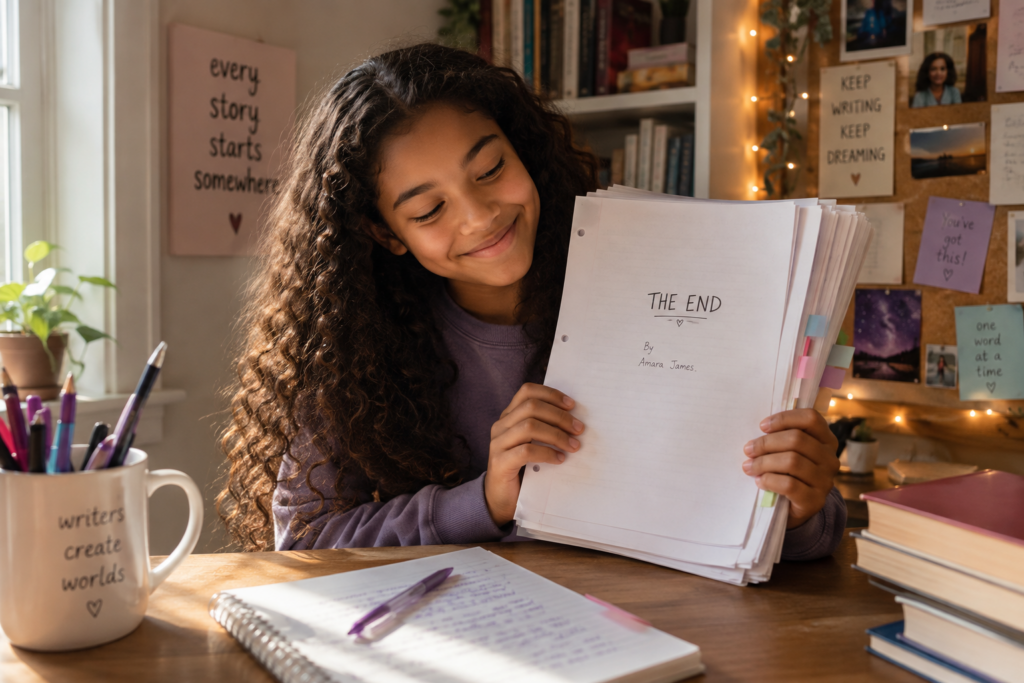
Does your child have notebooks full of brilliant story ideas but struggle to reach “The End”? Finishing a first book takes more than imagination. Young writers also need structure, consistency, encouragement and the confidence to keep going when the initial excitement wears off.
In this article, I share seven practical ways parents can support a child’s writing journey without taking over their story. From choosing a manageable project and creating a simple story plan to setting realistic writing goals, building a routine and navigating the difficult middle, these strategies help children turn exciting ideas into completed work.
I also explore when a young writer might benefit from additional support through a creative writing programme or dedicated writing mentor. The difference between an unfinished story and a completed manuscript isn’t talent, it’s having the right support at the right time.
Audio, digital, physical and interactive: 4 ideas for publishing your child’s book

There’s something incredibly special about a young writer seeing their name on the cover of a published book. But once your child has written their story, another question appears: what’s the best way to publish it?
This article explores four exciting options for publishing your child’s book: physical books, ebooks, audiobooks, and interactive or activity books. But there is no single format that suits every young writer.
The article encourages parents to consider their child’s personality, the type of book they’ve written and what they hope to achieve. Most importantly, children should be involved in the decision. Publishing isn’t simply about producing a book. It can teach creativity, perseverance, communication, confidence and ownership, while giving young writers the extraordinary experience of saying: “I wrote that.”
How beta readers can help your manuscript before you hire an editor

You’ve finished your manuscript, revised it, reread it and reached the point where you’re simply too close to the story to see what isn’t working. That’s where beta readers can be invaluable.
This article explains how beta readers act as test readers for a near-finished manuscript, helping authors discover plot holes, pacing problems, confusing character motivations, weak openings and unsatisfying endings before investing in professional editing.
Behind the scenes of our Summer Storytelling Camp (and what’s next for your child)

What happens when you put a group of young writers together and tell them to let their imaginations run wild? A LOT of stories!
Our Young Writers Summer Storytelling Camp was filled with characters, imaginary worlds, plotting, creative challenges, laughter and, most importantly, young people discovering the confidence to tell their own stories.
We explored character development, setting, story structure and the all-important question: “What happens next?”
Summer may be ending soon, but their writing journey doesn’t have to.
Our Creative Writing Club for Kids and Teens returns this September, giving young writers a supportive space to keep creating, learning and developing their storytelling skills throughout the term.
Does your child love books, make up stories, fill notebooks with ideas – or simply have an imagination that needs somewhere to go?
Registration for September is now open. Come and discover what your young writer can create!
10 reasons your novel progress has stalled (and how to finally finish your book)

Every writer knows the feeling. You begin your novel full of excitement, only to hit a wall halfway through. Suddenly the words stop flowing, self-doubt creeps in, and finishing your book feels impossible.
In this article, I explore the 10 most common reasons writers get stuck, from perfectionism and imposter syndrome to the dreaded “messy middle,” shiny new ideas, lack of routine, plot problems, and research rabbit holes.
More importantly, I share practical strategies to overcome each obstacle and regain momentum so you can finish your book.
If your manuscript has been gathering dust, this guide will help you identify what’s really stopping you and give you the confidence to finally type those two magical words: The End.
How to support and encourage a child who loves writing stories

If your child is always making up stories, filling notebooks with ideas, or disappearing into books for hours, they may have the heart of a young writer. The good news is that you don’t need to be a writing expert to nurture their creativity.
This article shares five practical ways parents can encourage a child’s love of storytelling without turning writing into another school assignment.
You’ll discover how creating a dedicated writing space, providing inspiring resources, celebrating imagination over perfection, becoming an enthusiastic audience, and helping your child connect with other young writers can build confidence and develop lifelong writing skills.
4 Self-Publishing Options for Your First Book: Audio, Digital, Physical, and Interactive

In this practical guide, author, publisher and writing coach Tolulope Popoola explores the four main self-publishing formats available to today’s authors and explains the advantages and disadvantages of each. You’ll learn which formats offer the greatest reach, the highest royalties, the strongest credibility, and the best opportunities to grow your author brand.
The article also explains why you don’t need to publish every format at once, offering a simple publishing roadmap that helps new authors launch strategically without becoming overwhelmed. Whether you’re writing fiction, memoir, children’s books or business books, you’ll discover how to choose the publishing format that best serves your readers and your long-term goals.
5 steps to use creative writing for your child’s emotional intelligence

This article explores how creative writing helps children develop emotional intelligence alongside their literacy skills. Rather than simply improving grammar or storytelling, writing gives children a safe space to understand and express their feelings, develop empathy, solve problems creatively, and build confidence.
The article highlights that emotional intelligence is built through consistent practice, not perfection. By nurturing a child’s imagination and giving them the freedom to explore emotions through stories, parents help them become not only better writers, but also more resilient, empathetic, and emotionally aware individuals.
The Legacy Project: Why your children and grandchildren need you to write your memoir

This article encourages parents, grandparents, and older adults to preserve their life stories as a lasting gift for future generations. It challenges the belief that only extraordinary lives are worth writing about, arguing that everyday experiences, family history, personal values, and lessons learned are often the most meaningful stories of all.
The article explores how memoir writing helps pass down family heritage, wisdom, resilience, and identity. It highlights research showing that children who know their family history tend to have stronger self-esteem and emotional resilience. Readers are encouraged to see their book as a legacy project that preserves their voice, experiences, and values for children and grandchildren.
Six signs your child might have a writing talent

This article helps parents identify six often-overlooked signs that their child may have a natural talent for writing. While writing ability isn’t always reflected in perfect spelling, neat handwriting, or top grades, it often reveals itself through curiosity, imagination, observation, empathy, and a deep love of stories.
The article outlines six key indicators of writing talent, including being an avid reader, having a vivid imagination, noticing small details others miss, demonstrating emotional intelligence, using writing to process feelings, and showing a fascination with words and language.
7 Mistakes you’re making with a blank page (and how to fix them)

This article tackles one of the biggest challenges writers face: the dreaded blank page. The fear of the blank page is often caused not by a lack of ideas, but by habits and mindsets that sabotage progress before the writing even begins.
The article identifies seven common mistakes writers make. For each mistake, practical solutions are offered, such as embracing messy first drafts, focusing on progress over perfection, and trusting your natural voice.
The key message is simple: writing a book is not about brilliance or perfection. It’s about persistence, consistency, and showing up even when the page is blank. The only way to defeat the blank page is to start writing.
Creative indoor activities for book-loving kids

This article gives parents practical and creative ways to keep book-loving kids engaged during the summer holidays. Rather than simply reading books, children are encouraged to interact with stories through activities such as creating book trailers, designing character scrapbooks, rewriting endings, building fictional worlds, casting movie adaptations, and starting book review blogs or Bookstagram accounts.
These activities help children develop critical thinking, creativity, storytelling skills, and confidence while making reading more interactive and fun. The article also highlights how these projects can be a natural stepping stone from being a reader to becoming a writer.
My child loves writing: what should I do next?

This article is a practical guide for parents who have realised that their child has a genuine love of writing. It explains that once a child begins filling notebooks with stories, poems, or even their own comics, the next step is to nurture that passion without turning it into pressure.
Parents should take their child’s writing seriously, create a dedicated writing space, fuel their creativity through reading, and focus on storytelling rather than grammar in the early stages. It also highlights the importance of celebrating their work, entering writing competitions, and seeking professional guidance when appropriate.
Most importantly, it reminds parents that writing is a craft that grows through encouragement, confidence, and consistent practice. With the right support, a child who loves writing today could become a published author tomorrow.
Memoir or Business Book? Helping professional women choose the right format for their story

This article helps professional women decide whether their story is best suited as a memoir, a business book, or a hybrid of both. It explains that a memoir focuses on personal transformation, emotional truth, and life experiences, while a business book is designed to teach, solve problems, and establish authority in a specific field.
For many women, the ideal solution is often a business memoir – a book that combines powerful personal stories with practical lessons and professional expertise. The article encourages aspiring authors to think carefully about their goals, audience, desired impact, and level of personal vulnerability before choosing a format.
It also addresses the common trap of overthinking and procrastination, reminding writers that clarity often emerges through the writing process itself. Ultimately, the message is simple: your story has value, and the most important step is to start writing.
Why creative writing is one of the best holiday activities for children

This article highlights why creative writing is one of the most valuable holiday activities for children aged 9–15. While many parents worry about boredom, excessive screen time, and the “summer slide” during school breaks, creative writing offers a fun and engaging way to keep young minds active.
The article explains how writing helps children maintain and improve literacy skills, including grammar, vocabulary, critical thinking, and communication. It also provides a safe outlet for self-expression, helping children process emotions, build empathy, and develop emotional intelligence.
Beyond academic benefits, creative writing encourages creativity, reduces screen time, and boosts confidence. Completing a story gives children a sense of accomplishment and ownership that can positively impact other areas of their lives.
The article also shares practical tips for motivating reluctant writers and suggests joining a writing community or summer storytelling programme to help children stay inspired and engaged throughout the holidays.
Conflict: Why your characters need a “No” before they get a “Yes”

I’ve seen it happen so many times. A talented writer comes to me with a beautiful premise, lovely prose, and characters they clearly adore. But about thirty pages in, the story just… stalls. It feels like a car that’s run out of petrol on a flat road. There’s no momentum, no urgency, and honestly, no […]
Stickers, stories and sweets: using rewards to keep your child motivated to write

This article explores how parents can motivate children to keep writing without turning creativity into a chore. Many children start stories with excitement but quickly lose momentum because writing can feel difficult, frustrating, or overwhelming.
The article explains how small rewards such as sticker charts, treats, screen-time swaps, and celebrating milestones, can help children push through the challenging parts of the writing process. It emphasises the importance of rewarding consistency and effort, not just finished stories.
Most importantly, the article encourages parents to balance external rewards with intrinsic motivation by giving children choice, autonomy, and a supportive creative environment.
The core message: writing confidence grows through encouragement, consistency, and making storytelling feel joyful rather than stressful.
Conversations: The secret to writing dialogue that flows instead of clunks

This article explores why writing natural, engaging dialogue is one of the hardest and most important skills in fiction writing. Great dialogue should feel realistic without copying real-life conversation word for word, which is often repetitive and dull.
The article explains common mistakes that make dialogue sound clunky. It also highlights the importance of subtext, rhythm, action beats, and reading dialogue aloud to improve flow.
The core lesson: dialogue should move the plot, reveal character, and create tension naturally.
Aspiring to Actual Writer: when you finally decide to start writing

This article explores the powerful moment when a writer moves from dreaming about writing to actually doing it. While imagining stories feels exciting and easy, the real transformation happens when you commit to the process and face the reality of writing a first draft.
It highlights the key mindset shift from “aspiring writer” to “active writer,” emphasising the importance of embracing imperfection, building discipline, and creating time intentionally.
Writing requires structure, consistency, and the willingness to push through resistance, especially during the difficult “messy middle” where many writers give up.