
Back-to-school writing: 5 ways to keep your child’s creativity alive this term

This article gives parents five practical ways to keep children aged 9 to 15 writing throughout the school term: create short, manageable writing habits; make reading and storytelling part of family weekends; celebrate small writing victories; turn school topics into inspiration; and protect unstructured time for imagination.
It also encourages parents to separate creativity from correction. Rather than focusing immediately on spelling, punctuation or producing a perfect finished story, children need opportunities to experiment, make mistakes and discover their own voices.
How to help a young writer finish their first book | Parent Guide
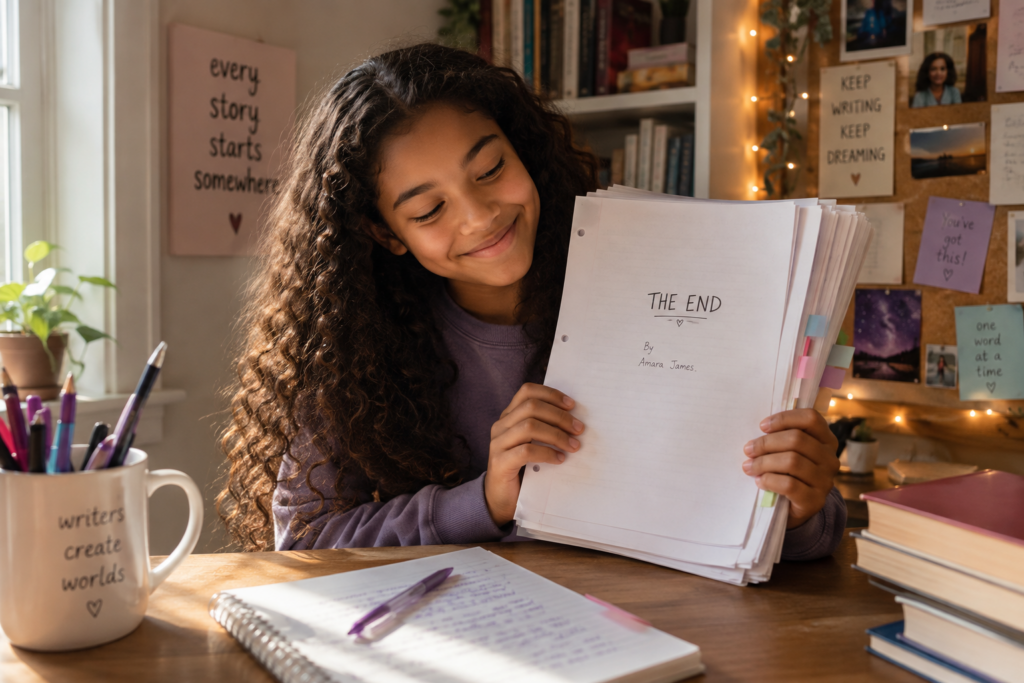
Does your child have notebooks full of brilliant story ideas but struggle to reach “The End”? Finishing a first book takes more than imagination. Young writers also need structure, consistency, encouragement and the confidence to keep going when the initial excitement wears off.
In this article, I share seven practical ways parents can support a child’s writing journey without taking over their story. From choosing a manageable project and creating a simple story plan to setting realistic writing goals, building a routine and navigating the difficult middle, these strategies help children turn exciting ideas into completed work.
I also explore when a young writer might benefit from additional support through a creative writing programme or dedicated writing mentor. The difference between an unfinished story and a completed manuscript isn’t talent, it’s having the right support at the right time.
Behind the scenes of our Summer Storytelling Camp (and what’s next for your child)

What happens when you put a group of young writers together and tell them to let their imaginations run wild? A LOT of stories!
Our Young Writers Summer Storytelling Camp was filled with characters, imaginary worlds, plotting, creative challenges, laughter and, most importantly, young people discovering the confidence to tell their own stories.
We explored character development, setting, story structure and the all-important question: “What happens next?”
Summer may be ending soon, but their writing journey doesn’t have to.
Our Creative Writing Club for Kids and Teens returns this September, giving young writers a supportive space to keep creating, learning and developing their storytelling skills throughout the term.
Does your child love books, make up stories, fill notebooks with ideas – or simply have an imagination that needs somewhere to go?
Registration for September is now open. Come and discover what your young writer can create!
How to support and encourage a child who loves writing stories

If your child is always making up stories, filling notebooks with ideas, or disappearing into books for hours, they may have the heart of a young writer. The good news is that you don’t need to be a writing expert to nurture their creativity.
This article shares five practical ways parents can encourage a child’s love of storytelling without turning writing into another school assignment.
You’ll discover how creating a dedicated writing space, providing inspiring resources, celebrating imagination over perfection, becoming an enthusiastic audience, and helping your child connect with other young writers can build confidence and develop lifelong writing skills.
5 steps to use creative writing for your child’s emotional intelligence

This article explores how creative writing helps children develop emotional intelligence alongside their literacy skills. Rather than simply improving grammar or storytelling, writing gives children a safe space to understand and express their feelings, develop empathy, solve problems creatively, and build confidence.
The article highlights that emotional intelligence is built through consistent practice, not perfection. By nurturing a child’s imagination and giving them the freedom to explore emotions through stories, parents help them become not only better writers, but also more resilient, empathetic, and emotionally aware individuals.
Featured Story Number #27 – The Superpower

On the last day of summer, four friends hold a long jump competition in a quiet driveway. But when one of them takes his turn, something impossible happens. Instead of landing on the pavement, he finds himself flying through his uncle’s grand manor house just like he did as a child. Moments later, he’s back on the driveway with his friends staring in shock.
How storytelling helps children reclaim agency

When children are given the space to tell stories, something powerful happens. They stop being passengers in their experiences and start becoming authors of them.
Through storytelling, children practice choice, they explore fear safely, they imagine solutions before they face them.
The brave princess, the misunderstood dragon, the child who finds their way through chaos; these aren’t “just stories.” They’re rehearsals for real life.
Featured Story Number #26 – Disaster at the Fair

When a thrilling fair ride malfunctions, Josephine and her friends race against time to save trapped passengers. Amid smoke, sparks, and rising panic, the teens battle fear and failure to shut down the runaway ride. Disaster at the Fair is an adventure about courage, teamwork, and acting fast in danger.
Featured Story Number #25 – The Cat in the Library

When mysterious sounds echo through an empty school library, Harper and her friends fear a ghost. Their mission leads to a heartwarming surprise. The Cat in the Library is a cosy mystery about friendship, bravery, and an unexpected new pet.
How to turn your child’s everyday experiences into story ideas

Seemingly ordinary moments in your child’s day are actually goldmines for creative writing ideas. Every scraped knee, every argument with a sibling, every trip to the grocery store contains the seeds of compelling stories.
Why creative writing should be in every school curriculum
Creative writing is not just some “nice-to-have” elective that gets cut when budgets tighten. Creative writing should be as fundamental to education as math and science.
Balancing screen time and writing time: tips for busy parents

Finding balance doesn’t mean eliminating screens entirely or feeling guilty every time your child picks up a tablet. It’s about creating intentional space for other activities: especially creative writing: that can be just as engaging and far more beneficial for their developing minds.
Why parents should embrace their child’s weird story ideas

Research shows that when children craft their own narratives, no matter how unconventional, they encounter situations that demand unique vocabulary, sentence structures, and creative problem-solving.
Debunking the “Natural Talent” Myth Aspiring Writers Believe

The “natural talent” myth is probably the biggest load of nonsense holding back aspiring writers today. Researchers have been studying this for decades, and the evidence is crystal clear: talent is developed, not inborn.
How to Support Your Young Author: Practical Steps for Parents

Supporting a young writer isn’t about becoming their editor-in-chief or their biggest critic. It’s about creating space for their creativity to flourish while giving them the tools and confidence they need to keep going. And trust me, there will be moments when they need that encouragement.
Why Working with a Writing Coach Beats Going It Alone

You don’t have to struggle and navigate the writing and publishing journey by yourself. Working with a writing coach can transform your writing experience from a lonely struggle into a guided, strategic path toward publication.
5 Common Creative Writing Mistakes Parents Make

As a parent, you want to nurture your child’s creative writing spark. You celebrate their stories, encourage their imagination, and maybe even dream of them becoming the next great author.
The 7 Biggest Creativity Myths That Parents Believe

As a parent, you want to support your child’s interests and talents. If your child shows musical talents, you get them a music tutor. But when it comes to creative writing, many well-meaning parents get stuck believing myths that actually hold their kids back. These misconceptions can prevent you from recognizing your child’s potential or […]
How Creative Writing Builds Emotional Intelligence in Children

If you’ve ever watched a child light up while telling you a story they’ve written, you’ve witnessed something pretty magical happening. Beyond the obvious joy of creation, that young writer is actually developing one of life’s most valuable skills: emotional intelligence. What does emotional intelligence actually mean? It’s your child’s ability to understand their own […]
When Your Child Loves Writing (But You’re Not Sure How to Help)

Picture this: Your child spends hours scribbling stories, creating elaborate fantasy worlds, or crafting poems about their pet hamster. They light up when talking about their latest character or plot. But when they ask for your feedback or get stuck on a story, you find yourself floundering. Maybe you’re not a writer yourself, or perhaps […]