


If your child is constantly scribbling in notebooks, narrating elaborate plots during car rides, or asking for “just five more minutes” to finish a chapter of their own story, you’ve got a young writer on your hands.
It’s an exciting place to be! As parents, we want to support our children’s passions, but writing can feel like a solitary and sometimes mysterious hobby. How do you help them grow without being overbearing? How do you provide guidance without making it feel like “extra homework”?
At Accomplish Press, we’ve worked with many young authors: including helping 10 and 12-year-olds publish their own books. We’ve seen firsthand that with the right environment, even the youngest writers can do incredible things.
Here is how you can encourage your child’s love for storytelling while keeping the spark alive.
1. Create a dedicated writing corner
Writing is a mental escape, and having a physical space that facilitates that escape makes a huge difference. You don’t need a massive home office; a small, quiet corner will do.
- Make it cozy: A comfortable chair, a desk at the right height, and good lighting are essential.
- Remove distractions: Try to keep the space away from the TV or high-traffic areas. This helps them get into “the zone.”
- Give them ownership: Let them decorate it. If they want posters of their favorite book characters or a mood board for their current story, let them go for it.
When a child has a space that is theirs, it signals that their writing is important and worthy of its own place in the home.

2. Stock up on resources and tools
Just as a painter needs brushes, a young writer needs tools. Sometimes, a brand-new notebook is all the motivation a child needs to start a new project.
- A variety of stationery: Provide different types of paper: lined for stories, blank for maps and character sketches, and even index cards for plotting out scenes.
- The ideas notebook: Encourage them to carry a small notebook everywhere. Writers often get their best ideas when they aren’t at their desks!
- A library card: This is the most valuable tool of all. Strong writers are almost always strong readers. Encourage them to explore different genres: fantasy, mystery, or even non-fiction and memoirs.
- Digital tools: If they prefer typing, ensure they have a safe, distraction-free way to use a computer.

3. Prioritize imagination over perfection
This is perhaps the most important rule for parents of young writers: Put the red pen away.
When a child shows you a story, they are showing you a piece of their imagination. If the first thing you point out is a spelling mistake or a missing comma, you risk turning off the creative flow.
In the professional writing world, we call the first version of a story the “discovery draft.” Its only job is to exist. Grammar and spelling are for the editing phase, which comes much later.
- Focus on the “what,” not the “how”: Instead of saying “You spelled dinosaur wrong,” try saying “I love how brave your main character is!”
- Encourage the messy phase: Let them know it’s okay to cross things out, use boring words for now, or leave a scene unfinished if they get stuck.
- Value the effort: Praise their persistence. Writing a full story is hard work!
4. Be an enthusiastic audience, not an editor
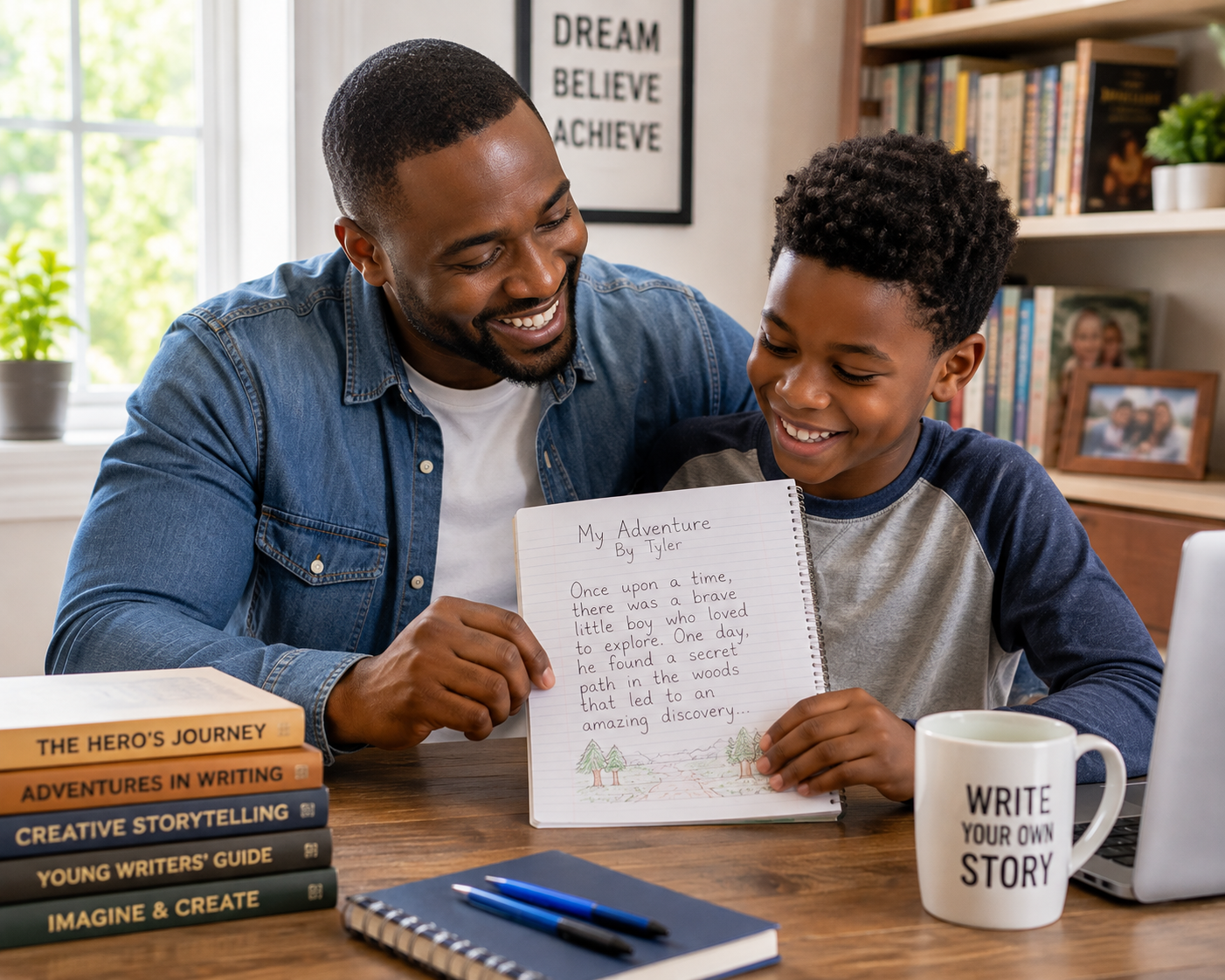
Your primary role right now is to be your child’s biggest fan. The young writer needs to know that their voice matters and that people are interested in what they have to say.
- Ask open-ended questions: Instead of just saying “That’s nice,” ask things like: “What happens next?” or “How did the character feel when they found the secret key?”
- Read aloud together: Sometimes, hearing their own words read back to them helps a child see how much they’ve actually achieved.
- Respect their privacy: Some children are happy to share everything, while others view their journals as private. Always ask before reading their work.
If you’re looking for more ways to guide them, our resource “Your Child Has Stories to Tell” is a great place to start for practical advice on nurturing that talent.
5. Help them find their tribe
Writing can be lonely. Connecting your child with other kids who share their passion can be a massive confidence booster. It shows them that they aren’t weird for loving words: they are part of a community.
Whether it’s a school writing group, an online forum for young writers, or a structured workshop like our Creative Writing Club, having peers to talk shop with is invaluable. They can trade ideas, offer each other “critique” (the friendly kind!), and realize that even other writers struggle with plot holes and writer’s block.

Keeping the momentum going
The goal isn’t necessarily to turn your child into a world-famous novelist by age 15 (though we’ve helped kids do just that!). The goal is to give them a tool for life. Creative writing builds empathy, improves communication, and helps children process their emotions and the world around them.
It takes patience, and there will be weeks where they don’t write a single word. That’s okay. Just keep the notebooks handy, the library books flowing, and the encouragement coming.
Let’s help your young writer grow
At Accomplish Press, we specialize in helping children and teenagers find their voice and build the confidence they need to succeed in writing and in life. Whether your child is just starting out or is already working on their first manuscript, we have the resources to help them get the stories out of their head and onto paper (or screen).
If you would like support for your young writer, consider working with me through a one-to-one coaching programme or joining one of our Creative Writing Courses for children and teens. Sometimes a bit of structure, guidance, and encouragement makes all the difference.
- Creative Writing Club for Kids and Teens: Join our community of young authors for interactive sessions that build confidence, literacy, and emotional intelligence.
- One-to-One Coaching: For children who want personalized guidance on their writing journey, our coaching programmes offer professional support to help them finish their books and develop their skills.
- Young Author Acceleration Programme: A dedicated path for those ready to take their writing to the next level.
Ready to see your child flourish? Let’s turn those stories into reality! Schedule a call with Writing Coach, Tolulope Popoola here.