
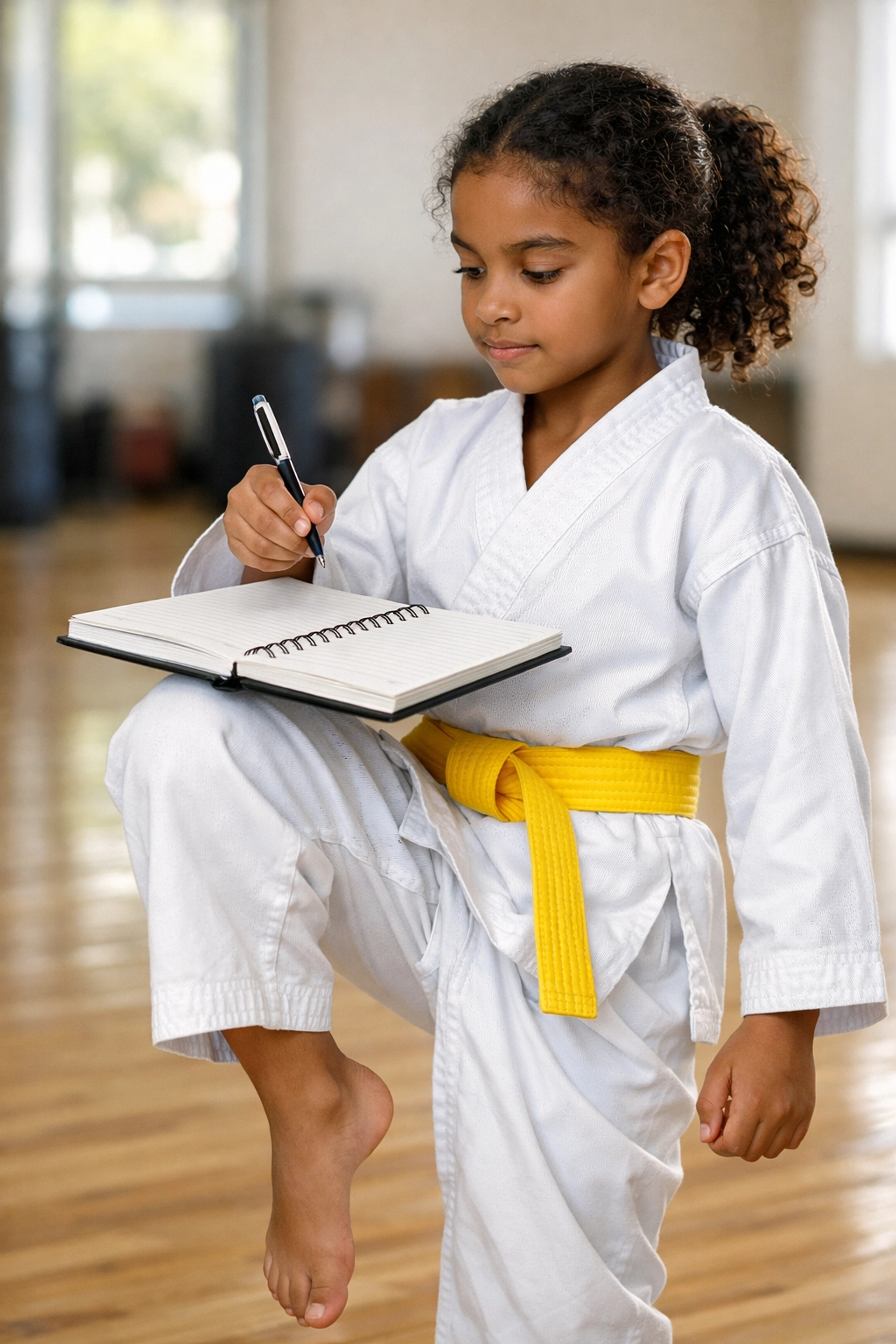
![[HERO] From the Pitch to the Page: Why Active Kids Make Great Writers](https://cdn.marblism.com/gERLv3pB90z.webp)
I’ve heard it more times than I can count. A parent comes to me, and says something like, “Oh, my son would never enjoy a writing club. He’s much too energetic. He just wants to be outside kicking a ball or climbing trees. He’s not the ‘quiet, bookish’ type.”
We tend to put kids into boxes. There’s the “sporty kid” who is all energy, and then there’s the “writer kid” who sits in a corner with a notebook and a pair of glasses. But I’m here to tell you that this is a complete myth. In fact, it’s a myth that might be holding your child back from discovering a talent they didn’t even know they had.
At Accomplish Press, we’ve seen all sorts of personalities come through our doors, or join our virtual classroom, and some of our most vivid, exciting stories come from the kids who can’t sit still. If your child is “energetic,” they aren’t “too active” to be a writer; they are actually perfectly primed for it.
The brain doesn’t discriminate between muscles and minds
We often think of physical activity and creative thinking as two separate entities, but they are deeply intertwined. Research into neuroscience shows that stimulation happens across the board when we engage our imaginations, and physical movement is one of the best ways to kickstart that process.
When a child is running around the pitch or practicing their backflip, their brain is firing on all cylinders. They are developing executive functions, the mental processes that help us plan, focus attention, and juggle multiple tasks. These are the exact same skills a writer needs to plot a story, keep track of characters, and see a project through to the end.
I’ve always found that the best ideas don’t come when I’m staring at a blank screen. They come when I’m walking, moving, or doing something completely unrelated to writing. For an energetic child, that movement isn’t a distraction; it’s fuel.

Sports are stories in motion
Think about the last sports movie you watched. Why was it so good? Because sports are packed with drama. There’s the underdog story, the last-minute tension, the crushing defeat, and the euphoric victory.
An active child understands these narratives better than anyone because they live them every weekend. When a child is into sports, they are already learning about:
- Conflict: The opposing team, the ticking clock, or their own personal best.
- Character development: Learning how to be a teammate, how to handle a “villain” (that one aggressive defender!), and how to grow from a loss.
- Sensory details: The smell of damp grass, the sting of cold air on their cheeks, the rhythmic thud of a ball, the roar of a crowd (even if it’s just three parents on the sidelines).
If your child can describe the feeling of scoring a goal or the frustration of missing a catch, they are already halfway to being a descriptive writer. In our Creative Writing Club for Kids and Teens, we encourage them to take those high-octane feelings and put them on paper. It turns boring writing into an adrenaline-filled activity.

The shared muscle: discipline and practice
One thing sporty kids have in abundance is a secret weapon for writing: discipline.
Active kids understand that mastery is a process. In sports, you know you don’t just walk onto the field and win a trophy. If you want to score a goal, you have to practice a thousand times. You have to run drills, practice your footwork, and listen to your coach. You have to do the “boring” stuff to get to the “fun” stuff.
Writing is exactly the same. It requires “writing muscles.” There are rules for writing fiction that need to be learned, and there are basic writing blunders we all have to work through. A child who is used to physical training understands that “practice makes progress.” They are often more resilient when it comes to editing and revising because they know that “getting it wrong” is just part of the game. They understand that the first draft might be messy, just like their first day at practice, but with consistency, they will improve.
Breaking the “quiet room” stereotype
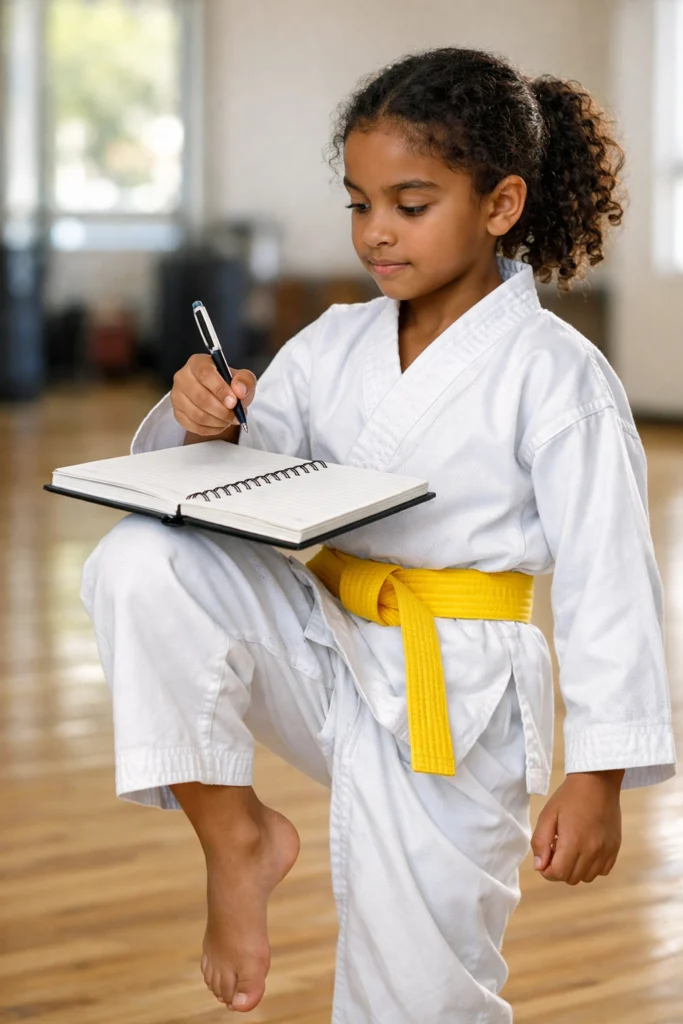
The idea that writing has to happen in total silence, while sitting perfectly still in a chair, is a recipe for boredom for any child, let alone an energetic one. We need to stop teaching writing as a “sedentary” chore and start seeing it as an “active” adventure.
If your child has too much energy to sit at a desk, let them write on the floor. Let them dictate their story into a phone while they pace around the room. Let them act out the scenes before they write them down. Writing doesn’t have a “posture” requirement. It just requires an imagination, and active kids usually have those in spades.

The “endorphin boost” for creativity
It’s a known fact that physical movement sparks creativity. How many times have you had your best ideas while walking, doing chores or in the shower? For kids, exercise increases blood flow to the brain and releases endorphins, which can clear mental blocks.
If your child is stuck on a story, tell them to go outside and run a lap around the house. Movement loosens up the mind. Active kids naturally have more “brain fuel” for their stories because they aren’t sedentary. Their physical energy keeps their mental energy high.
Focus and “the zone”
You might think an active kid lacks focus because they’re always moving, but have you ever watched a child during a karate or a tense tennis match? That is hyper-focus.
In sports, this is often called being in “the zone.” It’s a state of flow where everything else disappears, and you’re fully present in the moment. Writing requires the exact same mental state. Once an active child learns how to channel that athletic focus into their imagination, they can produce incredible amounts of work in a short time. They know how to block out distractions because they’ve had to do it on the pitch with people shouting from the sidelines.
How you can encourage the “sporty writer”
If you want to help your active child embrace their inner author, here are a few simple tips:
- Don’t make them sit still: Let them stand up to write, or use a clipboard so they can write outside.
- Use sports analogies: Talk about writing “practice,” “warm-ups” (freewriting), and “game day” (finishing a story).
- Encourage “Action” stories: Let them write about what they know. If they love football, let them write a sports thriller!
- Write “The Match Report”: After a game or a practice, ask them to write a one-page “report” as if they were a famous sports journalist. It’s a great way to practice non-fiction and descriptive language.
- Fictionize their Heroes: Ask them, “What if your favourite athlete was actually a secret agent?” or “What if the school basketball court was actually a portal to another world?”
- Focus on action scenes: Encourage them to write action scenes. Active kids are great at choreography. They can describe a chase scene or a fight scene with much more realism than someone who has never moved a muscle!
- Find a team: Writing can be lonely, which is why active kids often prefer our Creative Writing Club. They get to be part of a community of peers, sharing ideas and cheering each other on.
Channelling energy into stories
At the end of the day, writing is just another way to play. It’s a playground for the mind. When we tell an active child they “aren’t the writing type,” we are closing a door on a room they would probably love to run around in.
Our Creative Writing Club for Kids and Teens is designed specifically to be engaging. We don’t do boring lectures. We do prompts, challenges, and storytelling games that keep their minds moving as fast as their feet. We’ve seen “energetic” kids become the most prolific writers in the group because they have so much life experience and vitality to pour into their characters.
Whether they want to learn how to get published one day or they just want a place to vent their wild ideas, we provide the structure and the encouragement they need to get “unstuck” and moving.
Final thoughts
So, the next time you see your child zooming around the garden or coming home covered in mud from a match, don’t think, “They’ll never be a writer.” Instead, think, “Wow, look at all that material they’re gathering.”
If you have a child who loves to move but struggles to get their ideas down, I’d love to help them find their voice. My coaching and our writing clubs are all about making the process fun, accessible, and active.
Ready to turn that energy into an epic story?
If you’re looking for a way to support your child’s creative journey, our Creative Writing Club for Kids and Teens provides the structure, support, and professional guidance young writers need. Whether your child is 10 or 15, whether they’ve been writing for years or just discovered they have stories to tell, we help them find their voice and get their work published. We also have a Young Authors Acceleration Programme for exceptional young writers who are ready to take on a coaching pathway. Learn more about our coaching programmes or schedule a call with Tolulope Popoola to discuss how we can support your young author’s journey.